Guide

Curved Glass Partitions in Dubai: A Practical Guide

Flat glass partitions divide a room. Curved ones shape how people move through it. In Dubai's offices, showrooms and hospitality interiors, curved glass partitions have become one of the more requested upgrades over standard straight partitions — they soften sharp office layouts, guide foot traffic around reception and meeting areas, and read as a more considered, higher-end build without the cost of a full glass partitions overhaul.

GT

Glasser Technical Works Team

UAE glass & aluminium specialists since 2019

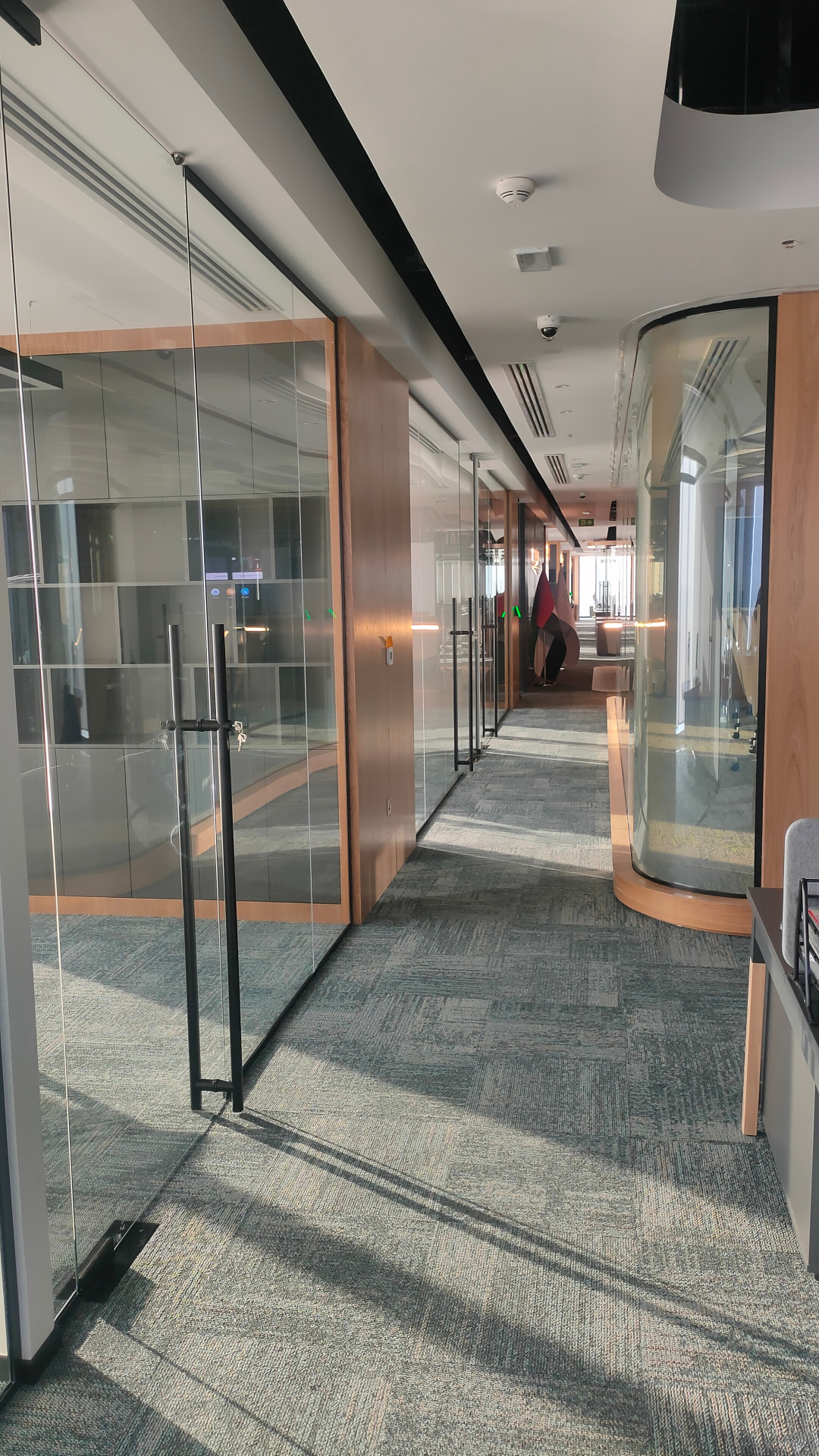
Curved glass partition in a Dubai office interior

At Glasser UAE, curved glass partitions are one of the more technical items we fabricate, since the glass itself has to be bent to a specific radius before it's ever installed. Here's what that actually involves, and what to expect if you're specifying one for a project in Dubai, Abu Dhabi or Sharjah.

How Curved Glass Is Actually Made

There are two methods, and the difference matters for both cost and lead time.

**Hot bending** is the standard approach for tighter curves and most interior partition work. The glass is heated to roughly 580–600°C and formed over rollers or a mold until it takes the target radius, then cooled slowly to avoid residual stress. This is how the majority of curved partition glass is produced worldwide, and it's what allows for the tighter, more dramatic curves you'll see in reception desks and feature walls.

**Cold bending** forces flat, already-tempered glass into a gentle curve using the framing system itself, without heat. It only works for shallow curves — generally large radii — but it's faster and more cost-effective when the design calls for a subtle bend rather than a tight one. It's the more practical option for something like a gently curved meeting room wall where the radius is wide and forgiving.

We help clients decide between the two based on the radius the design actually needs, not just cost — a tight curve simply isn't achievable with cold bending, so the drawing dictates the method more often than the budget does.

Where Curved Glass Partitions Get Used

The applications we see most often in Dubai and Abu Dhabi commercial fit-outs:

**Reception and lobby areas** — a curved partition behind or beside a reception desk is one of the most common uses, since it draws the eye without blocking sightlines.

**Meeting rooms and huddle spaces** — curved walls make small meeting rooms feel less boxed-in than a straight office glass partition would.

**Retail and showroom interiors** — curved glass display partitions are used to break up long runs of shelving or product display without a hard visual stop.

**Hospitality** — hotel lobbies and restaurant interiors use curved glass partitions as a softer alternative to feature walls.

Planning a project in the UAE?

Free site survey and fixed-price quote within 24 hours.

Get Free Quote

Safety: Tempered vs Laminated

Curved glass used architecturally needs to meet the same safety requirements as flat glass — bending it doesn't exempt it from that. In practice this means:

**Tempered curved glass** is standard for most interior partition applications — it's several times stronger than annealed glass and breaks into small, blunt fragments rather than sharp shards if it fails.

**Laminated curved glass** is used where retention matters more, or where the partition is hot-bent — hot-bent glass for architectural use generally needs to be laminated, since the bending process itself doesn't add mechanical strength.

We spec the glass type based on where the partition sits and what it's next to, not just on price — a partition next to a stairwell or public corridor gets treated differently than one inside a private office.

What Drives the Cost

Three things move the price on a curved glass partition in the UAE:

1. **Radius** — tighter curves cost more, since they require closer-tolerance molds and slower, more controlled bending.

2. **Glass build-up** — laminated and thicker glass costs more than a single tempered pane, but is often required for the application.

3. **Aluminium framing** — curved partitions need curved aluminium track and profiles matched to the same radius as the glass, which is custom work, not a stock item.

As a result, curved glass partitions typically cost more than an equivalent run of flat partitioning — but for a reception area or feature wall, that premium is usually the point.

Maintenance

Curved glass partitions are cleaned the same way as flat glass — a soft cloth and a standard glass cleaner, avoiding abrasive pads that can scratch the surface. The main thing to watch is the aluminium track: keeping it free of dust keeps the partition operating smoothly if it includes any sliding or folding sections.

Frequently asked questions

What's the difference between hot bent and cold bent glass partitions?+

Hot bending heats the glass to around 580–600°C and forms it into tighter curves; cold bending forces already-tempered flat glass into a shallow curve using the frame, with no heat involved. Hot bending suits tighter radii; cold bending suits wide, gentle curves.

Are curved glass partitions safe for offices in the UAE?+

Yes — they're specified in tempered or laminated glass to meet standard safety glazing requirements, the same as flat partitions.

How much does a curved glass partition cost in Dubai?+

It depends on the radius, glass build-up, and length of run — curved partitions cost more than flat ones because of the custom bending and matched curved aluminium framing. Contact Glasser UAE for a quote based on your drawings.

How long does a curved glass partition take to produce and install?+

Lead time depends on the radius and glass type specified, and is confirmed once the design and glass build-up are finalized.

Ready to spec a curved glass partition?

Share your drawings and target radius — we'll advise on hot vs cold bending, glass build-up and framing, and send a fixed-price quote.

Request a quote