Curved Glass Dubai: The Complete Guide to Bent Glass Design, Fabrication and Install
Curved glass Dubai projects have shifted from novelty to mainstream. Walk through Business Bay, Downtown or Palm Jumeirah and you will see curved glass wrapping tower crowns, spiral staircases in villas, cylindrical reception desks in DIFC lobbies and curved shopfronts in Dubai Mall. Whether the brief calls for a full curved glass facade, curved glass partitions in an executive suite, or bent glass Dubai supply for a hospitality fit-out, the material has become part of the standard palette for premium architecture in the UAE. This guide explains what curved glass is, how it is fabricated, where it works best in Dubai, and — importantly — what it realistically costs. If you already know you need bent glass as part of a larger scope, our glass facade Dubai and glass partition Dubai teams can size and detail the panels against the rest of the envelope.
GT
Glasser Technical Works Team
UAE glass & aluminium specialists since 2019 · 15 min read
What Curved Glass Is and Why Dubai Architecture Uses It
Curved glass is standard float glass that has been permanently bent into a defined radius. Unlike plastic, acrylic or laminated films, the curvature is baked into the substrate — there is no springback, no visible seam and, when specified correctly, the optical clarity is virtually indistinguishable from flat glass. That combination of transparency and geometry is precisely why curved glass Dubai specifications are so common on landmark projects: a curved panel lets architects soften rectilinear massing, wrap a lobby drum or continue a facade line around a corner without breaking it into faceted flat lites.
There is a climatic argument too. Dubai's low sun angles in winter and harsh overhead radiation in summer both favour surfaces that scatter and redirect reflected glare rather than bounce it straight back at neighbouring buildings. A gently curved glass facade behaves better under those conditions than a flat one — the reflections travel across the surface rather than concentrating into a single hot spot. On tower crowns and podium volumes, that is often the deciding factor when a design team is choosing between a curved and flat cladding strategy.
The other driver is signature identity. Developers along Sheikh Zayed Road, in Downtown Dubai and on the Palm compete hard on visual distinctiveness, and curved glass is one of the few materials that visibly separates a premium tower from a generic one at street level. It reads immediately as bespoke, which is why we see curved glass specified far more often on Dubai high-end residential and mixed-use projects than on comparable buildings in most other GCC cities.
Fabrication: Hot-Bent vs Cold-Bent, Tempered vs Laminated
There are two fundamentally different ways to produce a curved glass panel, and choosing between them is the first technical decision on any bent glass Dubai project. Hot-bent glass is fabricated by heating a flat float sheet to around 580–620°C in a bending furnace, then slumping it over a machined steel mould to the required radius. The panel is either rapidly quenched to produce toughened curved glass or slowly cooled to produce annealed curved glass ready for lamination or IGU assembly. Hot-bent is the correct choice for tight radii, complex geometries, staircases, partitions, shopfronts and anywhere the finished panel has to hold its curve without help from a frame.
Cold-bent glass, by contrast, is a flat panel that is mechanically forced into a curved frame at ambient temperature. The curvature is held by the frame and the panel remains under permanent stress. Cold-bending is significantly cheaper than hot-bending because there is no mould and no furnace time, but it is only viable for gentle radii — typically 2,000mm and above on toughened glass, and further constrained on laminated units. Cold-bent glass is popular on large facade projects where hundreds of panels each need a small amount of curvature; the tolerance stack is easier to control when the framing does the geometric work.
The second decision is the safety build-up. Tempered (toughened) curved glass provides four to five times the mechanical strength of annealed float and breaks into small blunt fragments if it fails, which is why it is mandated for balustrades, doors, shower enclosures and any glass at low level. Laminated curved glass bonds two or more curved leaves with a PVB or SGP interlayer; the interlayer holds fragments in place after breakage and adds acoustic and UV performance. On Dubai facades and skylights the specification is usually curved laminated toughened glass, often assembled into a curved insulated glass unit with a low-E coating and argon fill so the panel hits Dubai Municipality's thermal targets.
Tolerances matter more than most clients realise. A well-controlled bending line will hold radius to within ±2mm and edge alignment to ±1mm — critical for facades where curved panels must line through with flat neighbours. Cheaper suppliers running worn moulds produce panels that twist, dish or 'flat spot' at the edges, which causes visible reflections and installation gaps that no amount of gasketing can hide. When you are evaluating a curved glass supplier Dubai for a real project, ask for measured QA reports on their last three curved production runs, not marketing photographs.
Applications in Dubai: Facades, Retail, Villas and Offices
Curved glass facades are the highest-profile application. Towers along Sheikh Zayed Road, in Business Bay and in DIFC increasingly use cylindrical or freeform curved panels to soften rectilinear massing and create signature crowns. Curved insulated glass units are also standard on entrance canopies, revolving door enclosures and lobby drum walls, where the geometry needs to be seamless from inside and out. Because the curved unit carries the same low-E coating and IGU spacer as the flat facade around it, it can be swapped into the elevation without disrupting the thermal or acoustic performance the consultant has specified.
In retail and hospitality, curved glass earns its keep visually. A curved shopfront in Dubai Mall or Mall of the Emirates turns the storefront itself into a design feature and dramatically improves sight lines from the mall walkway — customers see product from further away and from a wider angle than a flat shopfront allows. Hotels use curved glass for lobby feature walls, bar counters, wine cellars and the enclosures around ceiling-height chandeliers, particularly on Palm Jumeirah and in Downtown properties where the fit-out budget rewards bespoke detailing.
Villa work is where curved glass moves from architectural statement to lifestyle detail. On Emirates Hills and Palm Jumeirah properties, we regularly install curved glass balustrades to spiral staircases, curved shower enclosures where a single seamless bend replaces a hinged corner, and curved feature walls around courtyards or plunge pools. Our glass railing Dubai team almost always specifies bent panels for spiral stairs — a single curved balustrade with concealed spigot fixings reads cleaner than a series of faceted flats trying to approximate a curve, and is dramatically easier to keep clean.
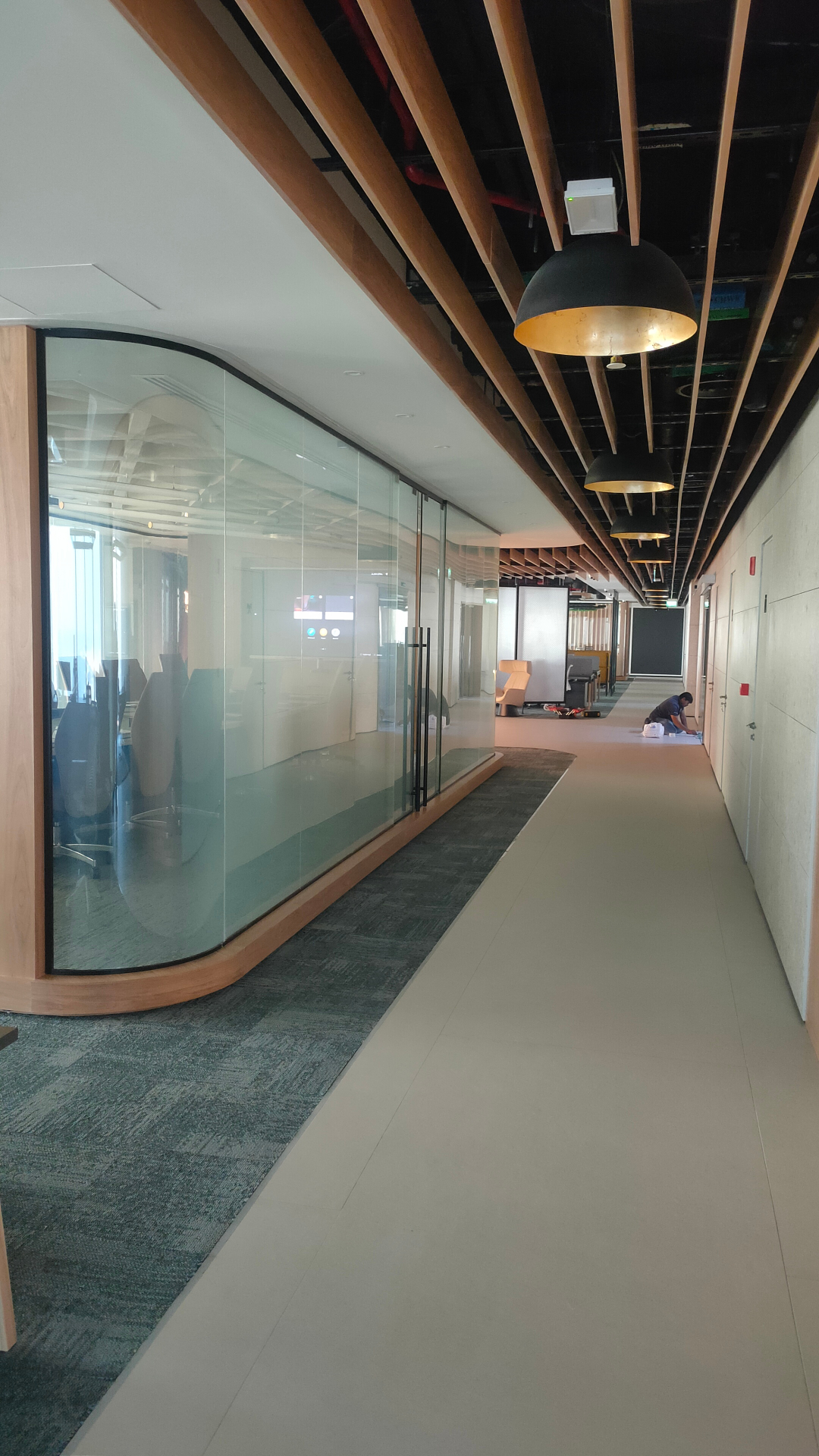
Office interiors are the fastest-growing category. Executive floors in DIFC, Business Bay and One Central are increasingly designed around curved glass partitions rather than the standard flat single- or double-glazed system. A curved boardroom wall lets the room read as sculptural rather than administrative; a curved reception desk with a matching curved glass screen behind it becomes the signature moment on arrival. When acoustic performance matters — which it usually does — the curved partition is built as a laminated toughened panel with an acoustic PVB interlayer, delivering the same 38–42 dB reduction as a flat acoustic partition. If you are specifying curved partitions as part of a wider office fit-out, our frameless glass partitions Dubai service handles the whole scope end to end.
Curved vs Flat Glass: When and Why
Curved glass is not automatically better than flat glass — it is a specific tool for a specific problem. Choose curved when the geometry genuinely requires it: a cylindrical lobby drum, a spiral staircase, a rounded corner where a mullion would break the elevation, a shopfront where sight lines matter, or a feature wall where the curve is the point. In those cases flat glass simply cannot deliver the design without visible faceting.
Choose flat when the curve would be so gentle that no one would perceive it, when the budget is tight, or when the programme is short. Curved glass adds four to eight weeks of fabrication time over flat, and any change to the radius mid-project means new moulds and new lead times. On a fast-track fit-out where the tenant is moving in twelve weeks, that is usually the deciding factor.
There is also a maintenance consideration. Flat glass can be replaced on site from stock in most metropolitan Dubai postcodes within a week. A cracked curved panel cannot — the mould has to be pulled, the replacement bent, tempered and delivered, which typically takes three to five weeks minimum. On critical elevations we recommend keeping one or two spare curved panels in storage from the original production run; the marginal cost is small and it protects the client from a long visible gap in the facade if a panel is damaged.
Cost Factors in Dubai: Realistic AED/sqm Guidance
Four variables dominate curved glass pricing in Dubai: the mould, the radius, the glass build-up and the panel size. The mould is a fixed tooling cost — a bespoke steel bending form runs AED 8,000–25,000 depending on size and geometry, and that cost is amortised over the number of identical panels produced from it. Ten identical curved panels cost far less per panel than one bespoke curve, which is why facade projects generally price out better than one-off interior pieces.
Tighter radii cost more because they demand slower bending cycles, more precise moulds and higher scrap rates. Laminated and double-glazed curved units cost more than single-toughened because each leaf has to be bent to matching radii and then assembled without introducing stress at the edges. Low-iron (ultra-clear) curved glass, which we recommend for showers, staircases and any panel above 12mm thick, adds roughly 25–35% over standard clear float.
As a rough Dubai supply-only guide: 8–10mm hot-bent toughened curved glass starts around AED 900–1,400 per sqm; 12mm curved laminated glass runs AED 1,600–2,400 per sqm; curved IGUs for facades typically land AED 2,200–3,200 per sqm. Cold-bent facade panels can come in 20–35% cheaper than hot-bent equivalents on large repeating elevations because the tooling burden is much lower. Installation, rigging, cranage, edgework, printed frit and site access are all separate and can be significant — a single curved facade lift on a high-rise in Business Bay often costs more than the panel itself.
One warning on budgeting. Cheap curved glass Dubai quotes almost always assume worn tooling, generous tolerances and imported panels shipped horizontally in bulk crates. All three assumptions cost money on site: worn moulds produce visible flat spots, loose tolerances mean site-cut trims, and horizontally shipped panels arrive with edge chips that fail QA. A properly priced curved glass supplier will quote higher, but the panels arrive fitting the drawings, which is what protects the programme.
Planning a project in the UAE?
Free site survey and fixed-price quote within 24 hours.
Curved glass installation begins long before panels arrive on site. The first step is a full site survey against the shop drawings — every curved panel is measured from the primary structure, not from adjacent finishes, because finishes drift and structure does not. Bracket positions, fixing centres and radius witness marks are set out on the substrate before the first panel is lifted. On a curved balustrade or partition we typically allow a full survey day per 20–30 running metres of curve.
Fabrication then runs in parallel with any adjacent trades. For a hot-bent curved partition, expect 3–5 weeks from approved shop drawings to delivered panels; for a curved laminated IGU facade unit, allow 5–8 weeks. During that window the site prepares fixings — floor and ceiling channels for partitions, curtain wall brackets for facades, stainless spigots for balustrades — all set to the surveyed geometry.
On the day of installation, curved panels are lifted in bespoke cradles that match the radius. Flat suckers do not work on curved glass; we use curved vacuum lifters or padded strap cradles rated to the panel weight. Site rigging for a facade unit typically means a crane or hoist plus a two-man handling team on each floor. Interior installations — curved partitions, staircases, showers — are handled with mobile A-frames and manual lifting jacks. Once panels are set to alignment, they are dry-glazed with structural silicone or mechanically fixed depending on the system, and gaskets are dressed in.
Total site time from first panel to sign-off varies widely. A curved shower enclosure in a Palm Jumeirah villa is usually a single-day job. A twenty-metre curved boardroom partition in Business Bay is 2–3 days. A curved facade lift of thirty units on a high-rise is a multi-week programme working around adjacent cladding and MEP trades. Our project managers sequence curved glass late in the fit-out — after wet trades, before final finishes — so that panels arrive to a clean, dust-controlled space.
Maintenance and Lifespan
Correctly specified curved glass has the same working lifespan as flat glass — 25–30 years for a laminated toughened panel, 30+ years for a well-sealed curved IGU. Failure modes are the same too: edge chips propagating into breakage, spontaneous NiS-inclusion breakage on toughened panels (rare, but the reason heat-soak testing is standard on facade specifications), and seal failure on IGUs. None of these are curved-specific problems.
Cleaning is straightforward. Curved glass takes the same pH-neutral glass cleaners as flat glass; on interior curved panels we recommend microfibre and de-ionised water to prevent streaking on the reflective side. On exterior facades in Dubai, curved panels benefit from the same twice-yearly facade cleaning cycle as flat glass — abseil or MEWP cleaning with soft brushes, no scouring pads or ammonia-based products on coated glass. Our maintenance team has cleaning schedules covering curved facades across Downtown Dubai and Palm Jumeirah properties.
The one curved-specific maintenance point is replacement lead time. Because curved glass cannot be swapped from stock, we strongly recommend keeping one or two spare panels in storage from the original production run for any critical curved facade or feature. The panels cost a small fraction of the original tooling amortisation, and they eliminate the risk of a 4–6 week visible gap in the elevation if a panel is ever damaged by impact or thermal stress.
How to Choose a Curved Glass Supplier in Dubai
Curved glass is unforgiving. A mis-radiused panel cannot be trimmed on site the way flat glass can — if the curve is wrong, the panel is scrap. Handling is also more demanding: curved panels have to be carried, stored and lifted on custom cradles to avoid point loads that cause spontaneous breakage. The consequence is that curved glass rewards specialists and punishes generalist glaziers.
When you are evaluating a curved glass supplier Dubai, ask for three specific things. First, in-house bending capability rather than sub-contracted overseas fabrication — imported bent glass arrives with tolerance and edge damage risk that local fabrication avoids. Second, measured QA data on their last three curved runs, not photographs. Third, references on curved projects of a similar scale to yours, ideally in the same emirate so you can visit the finished installation.
Glasser Technical Works LLC has been delivering curved glass across the UAE since 2019, with in-house fabrication, dedicated curved-panel rigging and installation crews covering Dubai, Abu Dhabi, Sharjah and the Northern Emirates. We have delivered curved glass on office fit-outs in DIFC and Business Bay, villa staircases on Palm Jumeirah and Emirates Hills, retail shopfronts in Dubai Mall and Mall of the Emirates, and curved facade panels on mixed-use towers along Sheikh Zayed Road. If your project includes bent glass as part of a wider envelope or interior scope, our glass facade Dubai team can integrate the curved elements with the flat cladding and framing so the whole thing lines through cleanly.
The best advice on curved glass Dubai projects is simple: bring the specialist in early. Curved glass decisions cascade into structural steel positions, floor levels, ceiling heights and lighting details that are painful and expensive to change once the shell is built. A one-hour design conversation at concept stage saves weeks of RFI at installation stage.
Curved Glass Performance in the Dubai Climate
Any glass specified for a UAE building has to answer three climate questions before anything else: how much solar heat does it let through, how much does it move as the day heats up, and how does it behave in a sandstorm. Curved glass answers all three the same way flat glass does — through coatings, cavity build-up and lamination — but the geometry changes how those layers are applied and how carefully they have to be checked.
Low-E and solar-control coatings are applied to flat sheets before bending. On hot-bent curved glass the coating goes through the bending furnace with the glass, so only bendable (heat-treatable) coating families can be used. That is the single most common specification clash we see on curved glass Dubai projects: an architect selects a high-performance soft-coat product from a flat-glass datasheet, and it turns out that coating is not available in a bendable variant. Selecting from the heat-treatable coating range at concept stage avoids a late redesign of the whole facade's thermal model. Typical achievable numbers on a curved double-glazed unit in Dubai are a shading coefficient around 0.24–0.30 with visible light transmission of 40–55% — close enough to flat-glass equivalents that the energy model rarely needs reworking.
Thermal movement matters more on curves than on flat panels. A curved panel restrained in a rigid frame cannot relieve expansion by flexing the way a flat panel can, so glazing gaskets, structural silicone joints and setting blocks all need slightly more generous tolerances. On south and west elevations in Dubai, where surface temperatures on dark-coated glass can exceed 75°C in July, we specify heat-soaked toughened glass and confirm the thermal stress calculation for each curved panel type rather than relying on a blanket facade assumption.
Sand abrasion is the quiet long-term risk. Fine airborne sand scours the outer surface of any exposed glass, and curved panels facing prevailing north-westerly winds catch more of it than flat panels set back behind reveals. Specify a hard-coat (pyrolytic) outer surface where curved glass sits in an exposed, unshaded position, and plan a regular cleaning cycle — abrasive damage on curved panels is far more expensive to replace than on flat ones.
Common Curved Glass Mistakes on Dubai Projects
The most expensive mistake is measuring late. Curved glass has to be templated from the built structure, not from drawings, because a 10mm deviation in a steel curve becomes a visible 10mm gap in the glass. On every curved project we insist on a physical survey after the substrate is complete and before the bending line is booked. Skipping that step is how projects end up with a 4–6 week rebending delay at the worst possible point in the programme.
The second mistake is under-specifying the radius. Tight radii look striking on a render but drive cost, distortion and breakage risk sharply upward — below roughly 600mm on 10mm glass you move into specialist territory with materially higher scrap rates. Where the architectural intent allows, easing the radius by even 200–300mm often halves the fabrication difficulty with no visible change to the finished space.
Third is mixing suppliers across one elevation. Bending furnaces have their own signatures — slight differences in optical distortion, edge roll-off and coating appearance. Two panels of identical specification from two different fabricators, installed side by side on a Sheikh Zayed Road elevation, will read as different in raking sunlight. Keep a single curved run with a single fabricator wherever possible.
Fourth is ignoring handling and access. Curved panels cannot be tilted through a doorway or stood on edge in a stairwell the way flat panels can. On villa staircases and interior features we plan the delivery route, crane or glazing-robot access and temporary protection before the panel is even fabricated. A perfectly made curved panel that cannot physically reach its opening is still a scrapped panel.
What is the minimum bending radius for curved glass in Dubai?+
For 6mm hot-bent toughened curved glass the practical minimum radius is around 300–400mm. Ten to twelve millimetre laminated curved glass typically needs 600–1,200mm depending on panel size. Cold-bent glass used on facades is limited to gentler curves — usually a radius no tighter than 2,000–3,000mm — because the panel is held in curvature by the frame rather than reshaped in a furnace.
How much does curved glass cost per sqm in Dubai?+
As a rough Dubai benchmark, 8–10mm hot-bent toughened curved glass starts around AED 900–1,400 per sqm supplied. Curved laminated glass runs AED 1,600–2,400 per sqm, and curved double-glazed IGUs for facades typically land AED 2,200–3,200 per sqm. Mould tooling, radius, panel size, low-iron glass and coatings all move the number.
Can curved glass be laminated or double-glazed?+
Yes. Curved glass can be laminated with PVB or SGP interlayers for safety, acoustic and security performance, and assembled into curved insulated glass units (IGUs) with argon fill and low-E coatings for facades and skylights that need to meet Dubai Municipality and Estidama thermal targets.
What is the difference between hot-bent and cold-bent curved glass?+
Hot-bent glass is heated to around 600°C and slumped over a steel mould, producing a permanently curved panel that keeps its shape once removed from the mould. Cold-bent glass is a flat panel that is mechanically forced into a curved frame at ambient temperature; the curvature is held by the frame and the panel is under permanent stress. Hot-bent is used for tight radii and structural applications, cold-bent for gentle facade curves at lower cost.
Are curved glass partitions practical for Dubai offices?+
Yes. Curved glass partitions are increasingly common in premium fit-outs in DIFC, Business Bay and Downtown Dubai, particularly for boardrooms, executive offices and reception areas. Curved partitions read as bespoke joinery rather than off-the-shelf systems, and pair well with acoustic laminated glass to keep meetings private without losing daylight.
How long does curved glass take to fabricate and install in Dubai?+
Typical lead time is 3–5 weeks from approved shop drawings for hot-bent toughened glass, and 5–8 weeks for curved laminated or curved IGU units, depending on mould availability. Site installation of a curved partition or staircase balustrade usually takes 1–3 days once panels are on site; curved facade panels are slower because each lift needs cranage and alignment against the primary structure.