Guide

Back Painted Glass in Dubai: Colours, Uses and Cost

Back painted glass has quietly become the finish of choice for Dubai kitchens, wardrobes and premium interiors. It gives you a seamless, high-gloss surface in any colour you can specify — with no grout lines, no seams and no fading — and it wipes clean with a damp cloth. This guide covers what back painted glass actually is, where it works best, the colour and finish options available in the UAE, and honest cost expectations. For coordinated interior finishes we often specify back painted glass alongside our custom mirrors so vanities, wardrobes and feature walls share the same edge details and installation method.

GT

Glasser Technical Works Team

UAE glass & aluminium specialists since 2019 · 13 min read

Back painted glass splashback in a modern Dubai kitchen

What Is Back Painted Glass?

Back painted glass is a sheet of clear or low-iron float glass with an opaque coating applied to the rear face. You see the colour through the front surface of the glass, which gives it a depth and gloss that no painted wall or tile can match. The paint is protected between the glass and the wall — nothing touches it in use — so the finish stays perfect for decades. That single structural fact explains almost everything people like about the material: it cannot be scuffed, it cannot fade from cleaning, and it cannot pick up the grease shadows that painted plaster and grouted tile accumulate in a working kitchen.

Two coating technologies dominate the UAE market. Ceramic frit is a mineral pigment fused to the rear face at high temperature during toughening — extremely durable, UV-stable, but limited to standard colour ranges. Two-part polyurethane (PU) or specialised back-paint enamel is applied post-fabrication and cured, allowing full RAL and Pantone colour matching. Both are suitable for interior use; ceramic frit is preferred where any UV exposure or high heat is expected, and PU is the practical choice whenever a designer has already committed to a specific brand or scheme colour.

The glass itself is normally 6mm for splashbacks and wall panels, 4–6mm for cabinet and wardrobe fronts bonded to a substrate, and 8–10mm for large unsupported feature panels or anywhere the panel spans between fixings. Splashbacks behind hobs must be toughened — that is a safety requirement, not a preference — and toughening also means any cut-outs for sockets, hobs or extractor hoods have to be made before the glass is heat-treated. There is no drilling or trimming a toughened back painted panel on site.

It is worth separating back painted glass from two things it is often confused with. It is not lacquered glass in the sense of a thin decorative varnish, and it is not printed glass. Digitally printed glass uses ceramic inks to reproduce patterns and images; back painted glass is a single uniform colour field. The two can be combined — a printed graphic over a solid back-painted ground is common in retail — but they price and behave differently.

Why Back Painted Glass Suits Dubai Interiors

Dubai interiors have three characteristics that back painted glass answers particularly well. The first is dust. Fine airborne sand settles on every horizontal and vertical surface in the emirate, and textured finishes — matte paint, grouted tile, brushed stone — hold it. A glass surface releases it with one pass of a microfibre cloth. In villa kitchens and staff-serviced apartments this alone is often the deciding factor.

The second is humidity. Coastal areas from Dubai Marina and Palm Jumeirah through to Jumeirah and Deira run high ambient humidity for much of the year, and bathrooms and kitchens in those buildings are hard on porous finishes. Grout darkens, silicone lines go grey, and painted walls behind vanities blister. Back painted glass has no porosity on its exposed face at all, so it stays visually identical from handover to year fifteen.

The third is the finish standard people expect here. Dubai fit-outs are benchmarked against hotel and showroom quality, and the seamless, mirror-flat gloss of a single large back painted panel reads as a considerably more expensive finish than the tile or painted MDF it replaces. On a cost-per-square-metre basis it often is not — a good large-format porcelain splashback with specialist installation can land in the same range — but the visual result is different, because there are no joints at all.

There is also a practical maintenance and service-charge argument. Owners of serviced apartments and short-let units in JVC, Business Bay and Dubai Marina tell us the same thing repeatedly: glass surfaces survive tenant turnover far better than painted ones. There is nothing to touch up between guests.

Where Back Painted Glass Works Best

Kitchen splashbacks are the single most popular application. A back painted glass splashback runs from the countertop to the underside of the wall units as one seamless panel — no grout to stain, no tile edges to catch grease, and you can wipe the entire surface with a single sweep. Because the glass is toughened, it comfortably handles heat from hobs and steam from cooking. On island units and open-plan layouts, where the splashback is visible from the living space, the seamless finish matters even more.

Wardrobe and cabinet doors in back painted glass are widely used in Dubai villas and apartments. The glass is bonded to a substrate and hung on standard cabinet hinges, giving a mirror-flat gloss finish that is far more scratch-resistant than lacquered MDF. In walk-in dressing rooms we often alternate back painted panels with mirror panels from the same fabrication run so that the edge polish, thickness and reveal are identical across the whole elevation.

Feature walls in living rooms, entrance halls and executive offices use large-format back painted glass panels — often paired with LED cove lighting for a subtle glow at the edges. In corporate reception areas, a back painted glass wall in the brand colour behind the desk is one of the most cost-effective ways to make a fit-out feel finished, and it pairs naturally with the frameless glass partitions behind it.

Retail displays use back painted glass as a backdrop for product shelves, particularly in jewellery, cosmetics and premium fashion where the seamless glossy finish reads as more expensive than painted MDF. Restaurants use back painted glass on bar fronts and behind open kitchens, where it satisfies both the design intent and municipality hygiene expectations for a washable, non-absorbent surface. Headboards, bedside panels, bathroom vanities, lift-lobby linings and back-lit signage panels round out the common uses.

There are places it does not belong. Exterior facades and balcony linings in full sun are a poor fit for PU-painted glass — specify ceramic frit or a proper spandrel panel instead. Floors are not an application for back painted glass. And any position where the panel will be repeatedly impacted at its edges, such as an unprotected external corner in a busy corridor, needs an aluminium trim rather than a bare polished glass arris.

Colour and Finish Options

Standard stock colours in the UAE include pure white, off-white, warm greys, charcoal, black, deep navy and warm neutrals — enough for most projects. Custom colour matching to RAL, Pantone or NCS references is straightforward and typically adds 20–35% over stock colours. Turnaround for custom colours is usually 7–14 days depending on batch size, and we always produce a physical sample on the actual glass thickness for sign-off before running the full order.

Beyond flat colours, back painted glass is also available in metallic finishes (bronze, champagne, gunmetal), pearlescent finishes, and textured or fabric-effect backings that show through the glass. Low-iron (ultra-clear) float glass is strongly recommended for pale colours and vivid brand colours — standard clear float has a slight green tint that shifts pale colours cooler than the sample chip. On whites and pale greys the difference between standard float and low-iron is obvious side by side, and it is the most common source of disappointment when clients skip the sample stage.

Finish choices include high-gloss (the default), semi-matte and full matte. Matte back painted glass is a newer option that gives a soft, tactile feel while retaining all the cleanability and seamless-panel benefits of the material. It also hides fingerprints noticeably better than gloss, which is worth considering on wardrobe fronts and any panel at hand height.

One specification point that catches people out is lighting. A gloss back painted panel is a partial mirror, so it will reflect whatever faces it — downlights, an untidy worktop, the opposite wall. In a kitchen with a strong downlight run, a semi-matte finish or a slightly deeper colour often gives a calmer result than a bright gloss white. Where the panel is back-lit or edge-lit, use low-iron glass and a translucent rather than fully opaque coating, and confirm the LED colour temperature against a sample.

Planning a project in the UAE?

Free site survey and fixed-price quote within 24 hours.

Get Free Quote

Installation Process

Installation of back painted glass is straightforward but has to be done properly to avoid ghosting or adhesive bleed showing through. The wall or substrate must be flat, dry and free of dust — plaster is skimmed and primed, tile beds are levelled. The glass is cut and edge-polished to size, toughened for splashback use, then painted and cured under controlled conditions.

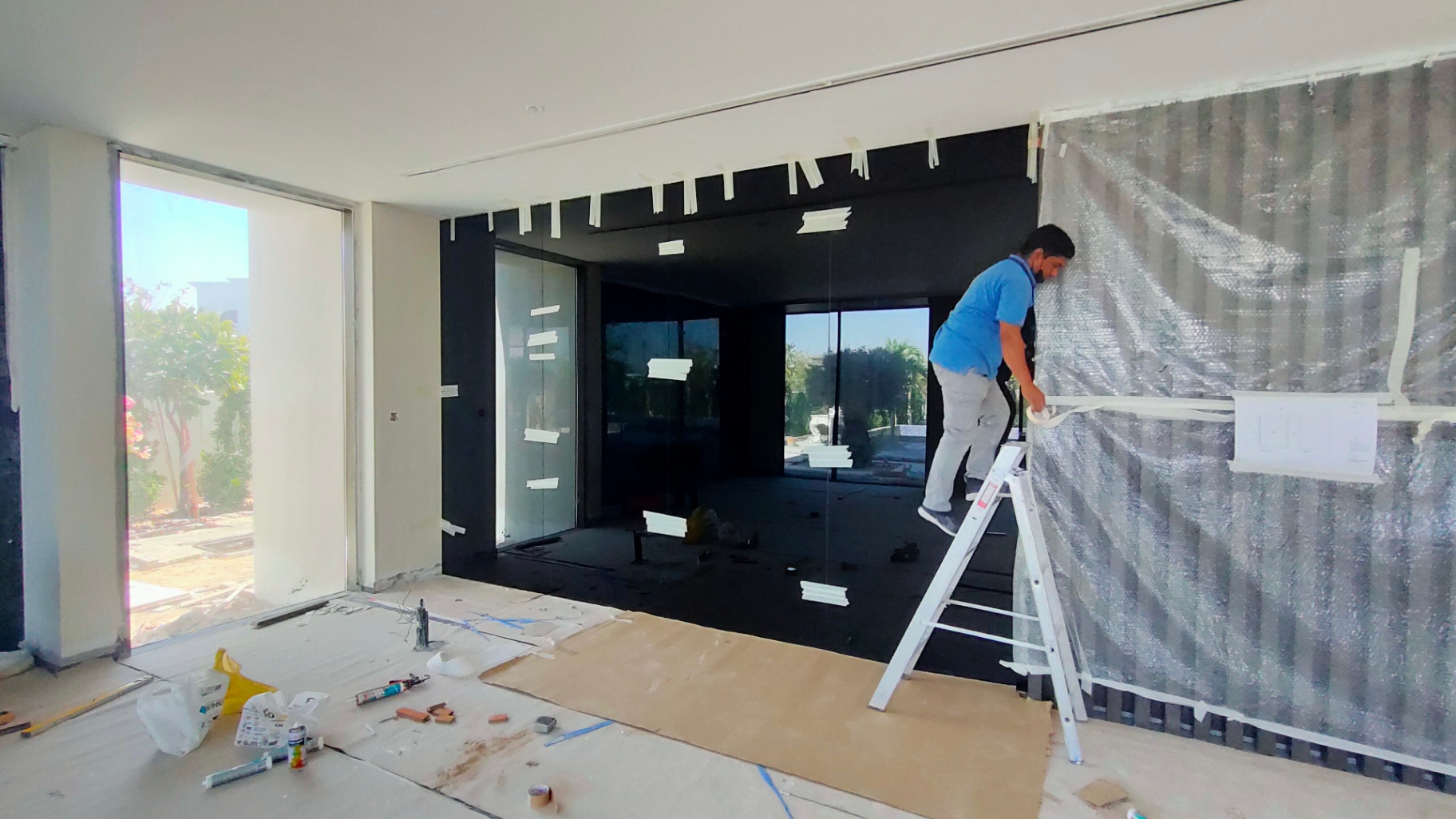
Templating is the step that determines whether the job looks right. We measure on site after the worktop is installed and the wall units are hung, never from drawings, because a 3mm error at the worktop junction is visible in a way that the same error in tile would not be. Socket positions, hob centrelines and extractor cut-outs are recorded from the built condition and transferred to a physical or digital template.

On site, panels are bonded using a neutral-cure silicone adhesive rated for glass bonding, applied in vertical beads with double-sided tape to hold the panel while the silicone cures. Acetic-cure silicone must never be used — it can attack the paint layer and cause visible discolouration months later. Perimeter joints are then finished with a matching silicone bead. A well-executed splashback install for a typical Dubai kitchen (3–5 sqm) takes a single day from delivery to finished silicone.

Where panels exceed roughly 2.4m in length, or where an elevation turns a corner, joints are planned deliberately at a logical position — a hob centreline, a cabinet edge — rather than left to fall wherever the sheet size ends. A butt joint in back painted glass is a fine 2mm shadow line and is far less obtrusive than an off-centre panel. Cut-outs are always factory-made from the measured template, not on site.

Durability and Maintenance

Back painted glass is one of the lowest-maintenance interior finishes you can specify. The front surface is glass — it does not stain, absorb or discolour, and it cleans with any standard glass cleaner or a damp microfibre cloth. The paint on the rear is protected between the glass and the wall, so it cannot be scratched, chipped or faded in normal use.

In kitchens, properly cured back paint is unaffected by heat from cooking, water splashes, or cleaning chemicals including citrus and mild alkalis. Toughened glass handles the thermal shock of hot pans nearby without issue. Avoid abrasive scouring pads on the front face — they will not scratch the glass but can dull the surface over years. Avoid ammonia-heavy cleaners at exposed edges, where they can creep behind the arris over time.

In bathrooms, ensure any silicone joints are neutral-cure and mould-resistant, and that the substrate behind the panel is genuinely dry before bonding. Trapped moisture behind a sealed glass panel is the one failure mode worth designing against; it shows as a faint cloud or discolouration visible through the paint. In direct-sunlight positions, specify ceramic frit rather than PU paint for long-term UV stability.

Realistic lifespan for a correctly installed interior back painted glass panel is the life of the fit-out — 15 to 25 years with no intervention beyond cleaning. If a panel is ever damaged, it is replaced rather than repaired, which is why keeping the colour reference and glass specification on file matters: an exact rematch years later is easy with the original RAL or Pantone number and impossible without it.

Back Painted Glass vs Tiles, Stone and Acrylic

Against ceramic or porcelain tile, back painted glass wins on cleanability and seamlessness and loses on repairability. A single cracked tile can be replaced for very little; a cracked glass panel means refabricating the whole panel. Tile also offers pattern and texture options glass cannot. For a busy family kitchen where the priority is wiping down quickly, glass is the better choice; for a heavily textured or traditional scheme, tile still makes sense.

Against natural stone and large-format porcelain slabs, back painted glass is usually cheaper installed, considerably lighter, and completely non-porous — no sealing, no etching from lemon or vinegar. Stone offers depth and veining that a flat colour cannot imitate. Where budget and maintenance drive the decision, glass generally wins; where the scheme is built around material character, stone does.

Against acrylic or composite splashback panels, back painted glass is significantly more heat-resistant, scratch-resistant and colour-stable. Acrylic is lighter and cheaper and can be cut on site, which makes it attractive for quick refurbishments, but it scratches from ordinary cleaning, softens near heat sources and yellows over time in bright rooms. It is not a like-for-like substitute behind a gas hob.

Against painted plaster, the comparison is simply durability. A painted wall behind a hob in a Dubai apartment typically needs repainting every two to three years. A back painted glass panel needs nothing.

Back Painted Glass Cost in Dubai

As a 2026 UAE reference: standard stock colours in 6mm toughened back painted glass run AED 220–380 per sqm supplied and installed. Custom RAL or Pantone colours add roughly 20–35%. Low-iron glass adds a further 25–30% and is worth it for pale, warm or brand-critical colours. Metallic and pearlescent finishes typically land AED 450–650 per sqm.

For a typical Dubai kitchen splashback of 4 sqm in a standard white, expect around AED 1,200–1,500 supplied, installed and sealed. A large feature wall of 15 sqm in a custom colour with low-iron glass will land closer to AED 6,500–8,500. A set of eight bonded wardrobe fronts in a stock colour usually falls between AED 2,800 and AED 4,200 depending on size and hardware.

The variables that actually move a quotation are, in order: glass type (standard float vs low-iron), colour (stock vs custom match), panel size and quantity of cut-outs, edge treatment, and access. Small quantities carry a disproportionate share of setup cost, so combining a splashback, a feature wall and wardrobe fronts into one order is materially cheaper than ordering them separately over three months. Access matters more than people expect — a 2.8m panel going to a high-floor apartment with a small service lift may need to be split into two panels, which changes both price and appearance.

Beware of quotations that look far below this range. The usual shortcuts are annealed rather than toughened glass behind a hob, thin single-coat paint that shows roller shadow through the glass, acetic silicone, and site-cut sockets. All four are visible or dangerous within the first year. Glasser UAE provides free site measurements and written fixed-price quotations across Dubai, Abu Dhabi, Sharjah and the Northern Emirates, and we quote the glass type, coating system and edge finish explicitly so quotations can be compared like for like.
How to Order Back Painted Glass in the UAE

The sequence that produces the best result is consistent across projects. Agree the colour on a physical sample produced on the actual glass and thickness you intend to use, viewed in the room's own lighting — not from a printed swatch or a screen. Confirm gloss level at the same time. Then finalise the substrate: plaster skimmed, primed and fully dry, tiling removed, worktop installed.

Only then book the site template. From template to installation is typically 7–10 working days for stock colours and 12–18 for custom matches, and that window is fixed by paint curing, not by scheduling — rushing it is the main cause of adhesive ghosting. Plan the trade sequence so that electrical fit-out and worktop installation are complete before templating, and final silicone and socket faceplates come after the glass.

Ask any supplier for four things in writing: glass type and thickness, toughened or annealed, coating system (ceramic frit or two-part PU) and the colour reference, and the adhesive and sealant specification. A supplier that answers all four clearly is a supplier who has done this before.

Glasser Technical Works LLC fabricates and installs back painted glass across the UAE from our Al Qusais facility, alongside custom mirrors, shower enclosures and partition work — which means a single fit-out can source every glass element from one production run with matching edges, thicknesses and colour references. Send dimensions, a colour reference and a photo of the space and we will come back with samples and a fixed-price quotation within 24 hours.

Frequently asked questions

What is back painted glass?+

Back painted glass is toughened or annealed float glass with an opaque coating applied to the rear face. You see the colour through the front of the glass, giving a smooth, glossy, seamless finish that is impossible to achieve with paint on a wall or tiles with grout.

Where is back painted glass typically used in Dubai?+

Kitchen splashbacks, wardrobe doors, feature walls in living rooms and offices, headboards, retail display backgrounds, and back-lit signage panels. Any surface where a glossy, easy-to-clean, grout-free colour finish is wanted.

How much does back painted glass cost per sqm in Dubai?+

Standard colours in toughened back painted glass run AED 220–380 per sqm supplied and installed. Custom RAL or Pantone colours, low-iron glass, and metallic or textured finishes push pricing to AED 400–650 per sqm.

Is back painted glass durable in a kitchen?+

Yes. A properly specified back painted glass splashback uses toughened glass with a ceramic frit or two-part polyurethane paint that is fully cured and sealed. It resists heat, moisture and cleaning chemicals for the lifetime of the kitchen and is far easier to clean than tiles or stone.

Can any colour be matched for back painted glass?+

Yes. Glasser UAE supplies back painted glass in standard whites, greys, blacks and warm neutrals from stock, and matches custom RAL, Pantone and NCS colours to order. Low-iron glass is recommended for pale or vivid colours to preserve true tone.

Considering back painted glass?

Share colour references and dimensions — we'll send samples and a fixed-price quote within 24 hours.

Request a quote